AI Detection for Authors: What Humanization Means Before You Publish
August 21, 2026
Book Formatting for Self-Published Authors: What Readers Notice First
August 26, 2026Book indexes and glossaries: When nonfiction authors need them

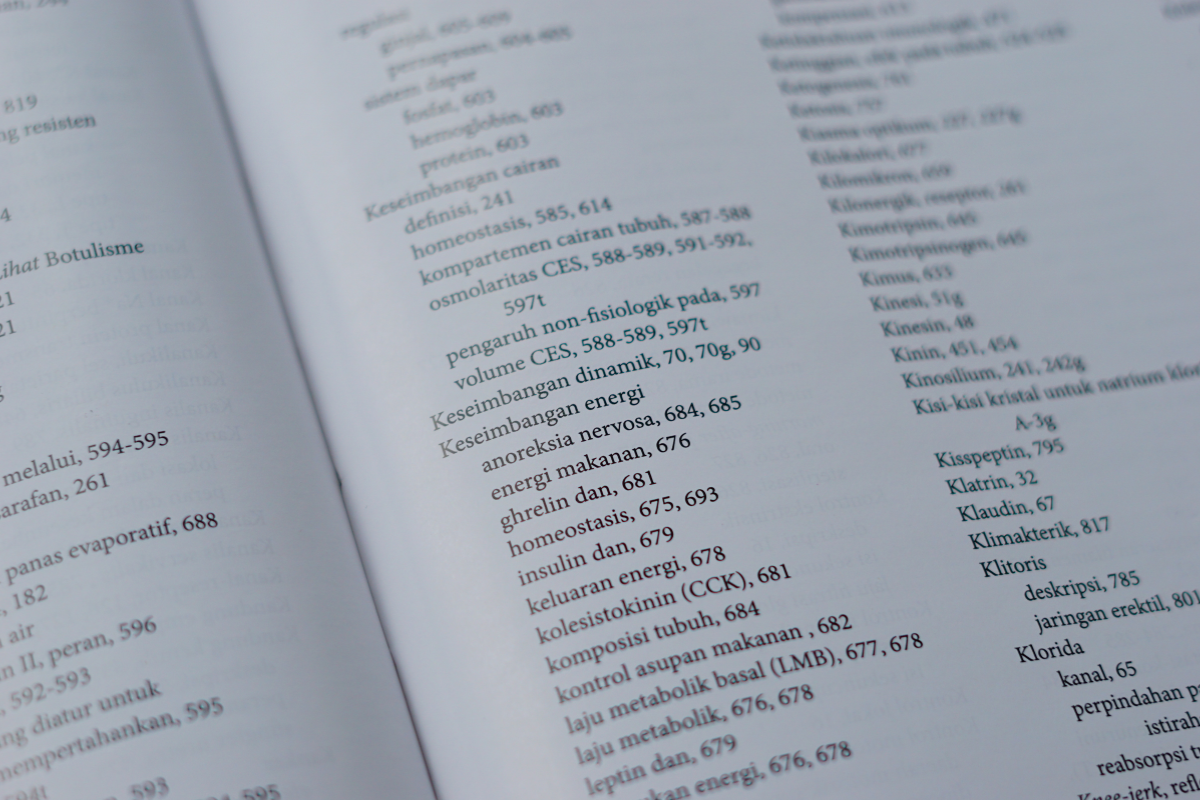
A reader remembers a useful framework from your book, but they cannot recall where in your book it appeared. They scan the table of contents, flip through several chapters, and look for a phrase they vaguely remember. After a few frustrating minutes, they give up.
When a reader does that, it’s not because your ideas were unclear or unimportant. The reader simply did not have an effective way to find them again.
For many nonfiction books, the reading experience continues long after the final chapter. Readers return to locate a process, revisit an example, define a term, prepare a lesson, or apply a recommendation. That return journey can be easier with book indexes and glossaries.
Nonfiction authors generally need an index when readers are likely to look up specific topics, people, methods, or examples after reading. A glossary is useful when a book contains specialized, unfamiliar, or author-defined terms. Technical, instructional, business, spiritual, and academic-adjacent books may benefit from both.
The goal is not to add more pages for the sake of making a book look substantial. You want to anticipate how readers will use the information you have worked so hard to share.
What are book indexes and glossaries?
Indexes and glossaries are usually included in a book’s back matter, but they serve different purposes.
An index tells readers where information appears. A glossary tells readers what a term means. A table of contents tells readers how the book is organized.
Understanding those distinctions helps you decide which navigation tools genuinely serve your audience.
What is a book index?
A book index is an alphabetically arranged list of subjects, names, concepts, places, or other access points, along with the pages or locations where relevant information appears.
The American Society for Indexing describes an index as a navigation tool that lets readers find specific information without searching through the entire book.
A well-developed nonfiction book index might include entries such as:
leadership
—adaptive, 47–49
—during organizational change, 112–118
—remote teams, 153–155
—see also communication; management
This structure does more than show where the word leadership appears. eaders use it to distinguish among related applications of the subject, and it directs them to other useful concepts.
A long list of repeated words and page numbers is not automatically a reader-friendly index. Effective indexing involves identifying meaningful ideas, anticipating the language readers use, and organizing related information clearly.
What is a book glossary?
A glossary is an alphabetized list of selected terms and their definitions. It is particularly useful when a book contains:
- Technical or industry-specific language
- Acronyms and abbreviations
- Translated or original-language terms
- Unfamiliar spiritual, scientific, or philosophical concepts
- Words that carry a specialized meaning within the book
- Terminology created for an author’s proprietary framework
A glossary gives readers a quick reference point without requiring them to search for the chapter where a term was first explained. Digital publishing platforms offer additional ways to connect definitions to the text. For example, Pressbooks provides guidance on creating and displaying glossary terms in an alphabetized back-matter list and across book formats.
A glossary should be selective. Its purpose is to remove barriers, not to reproduce definitions for every term used in the manuscript.
How are indexes, glossaries, and tables of contents different?
| Feature | Index | Glossary | Table of contents |
| Primary purpose | Locates specific subjects and concepts | Defines selected terms | Shows the book’s major sections |
| Typical location | Back matter | Usually back matter | Front matter |
| Organization | Alphabetical entries with page references or locators | Alphabetical terms with definitions | Order of appearance |
| Best for | Returning to information across the book | Understanding terminology | Navigating chapters and sections |
| Requires final page numbers | Usually for a print edition | No | Usually added during formatting |
These tools complement one another. A detailed table of contents may help readers find a chapter about leadership, but it will not necessarily show every page discussing delegation. An index locates those references, while a glossary explains any specialized leadership terminology the author uses.

Does your nonfiction book need an index?
Your book probably needs an index if readers will return to it to locate specific information rather than rereading entire chapters.
Consider how the book will be used. Is it primarily a sequential reading experience, or will it become a resource readers consult while solving problems, teaching others, conducting research, or making decisions?
An index may be especially valuable when:
- The book covers interconnected subjects across several chapters.
- Important concepts appear in more than one location.
- Readers may search for individual people, organizations, places, events, studies, methods, laws, or examples.
- The book is intended for professional, educational, scholarly, or reference use.
- Instructors, researchers, reviewers, librarians, or practitioners may consult it.
- The reader may need to revisit a process while completing a task.
- Comparable books in the category commonly include indexes.
Indexes are frequently useful in business, technical, historical, theological, instructional, scientific, medical, legal, and academic-adjacent nonfiction. Some memoirs and narrative nonfiction books benefit from a name or subject index when they involve numerous people, locations, dates, or historical events.
Authors working with professional nonfiction book publishing services evaluate this decision in the context of the book’s audience, category, format, and long-term purpose.
The question is not whether every “serious” book has an index. The better question is whether your readers need one.
Does your nonfiction book need a glossary?
Your book needs a glossary when readers must understand recurring terms that are unfamiliar, specialized, abbreviated, translated, or defined in a particular way.
A glossary may improve the reader experience when:
- The manuscript uses industry terminology or jargon.
- The intended audience includes beginners or general readers.
- Acronyms and abbreviations appear throughout the book.
- The author has developed a named process, model, or proprietary vocabulary.
- Common words carry a specific meaning within the manuscript.
- Definitions are introduced across several chapters.
- The subject includes specialized cultural, spiritual, philosophical, scientific, or technical language.
- Readers may need a quick reminder after a concept’s initial explanation.
Imagine a business author who creates a five-part leadership model. Each stage has a specific name and definition. Even when those terms are explained in the main text, a glossary gives readers one convenient place to review the full model.
A spiritual or philosophical author might use a glossary for original-language words, traditions, or practices that are meaningful to the subject but unfamiliar to many readers. A technical author might define equipment abbreviations, system components, or recurring error codes.
The glossary should make the book more accessible without flattening necessary nuance. Definitions should be concise, consistent with the manuscript, and written for the reader’s level of knowledge.
When does a nonfiction book need both?
Some books need both an index and a glossary because each tool solves a different reader problem.
For example:
- A leadership book might use a glossary to define the author’s proprietary framework and an index to locate examples involving delegation, communication, feedback, and conflict.
- A spiritual book might define original-language terms or unfamiliar practices in a glossary while indexing scriptures, teachers, traditions, and recurring themes.
- A technical manual might define acronyms and equipment terminology in a glossary while indexing procedures, components, warnings, errors, and troubleshooting instructions.
- An academic-adjacent book might define disciplinary vocabulary while indexing scholars, theories, case studies, research findings, and major concepts.
- An instructional book might define specialized tools in a glossary while using an index to direct readers to specific techniques and applications.
Including both is worthwhile only when each performs a distinct function. Repeating the same list of terms in two formats will not necessarily improve the book.
When might you not need an index or glossary?
Not every nonfiction book requires additional reference tools.
An index is unnecessary when the book is brief, highly sequential, or organized so each subject appears in one clearly labeled chapter. A reflective essay collection or motivational book intended to be read from beginning to end is easy to navigate with a strong table of contents and descriptive headings.
A glossary is unnecessary when the book uses familiar language, introduces only a few new terms, or clearly defines each concept where it first appears. Adding a glossary simply to make a book look academic creates clutter rather than clarity.
Category expectations also matter. Readers of a detailed historical reference book may reasonably expect an index. Readers of a short inspirational narrative may not.
Professionalism does not come from including every possible element of front and back matter. As with the editing, typography, structure, and design choices that determine what makes a book feel professional, quality comes from making deliberate decisions that support the reader.

What makes an index or glossary genuinely useful?
The presence of an index or glossary does not automatically improve a book. Quality depends on how thoughtfully the material is selected and organized.
A useful index is selective and reader-centered
A strong subject index includes the ideas readers are most likely to search for, even when their search language differs from the author’s exact wording.
Useful indexes may include:
- Main entries for important subjects
- Subentries that separate different aspects of a broad topic
- Synonyms and alternate access points
- Cross-references such as “see” and “see also”
- Consistent treatment of names and terminology
- Specific, accurate page references
- Entries based on meaningful discussion rather than passing mentions
Suppose a book discusses the risks of overwork without frequently using the word burnout. Readers may still look under “burnout” in the index. A thoughtful index directs them to the relevant discussion because indexing requires conceptual judgment, not only word matching.
Avoid long strings of page numbers with no subentries. Readers should not have to visit twelve pages individually to determine which one contains the information they need.
A useful glossary is concise and consistent
Every glossary definition should match the way the term is used in the manuscript. Ensure the definitions are understandable to the intended reader.
Review each glossary entry for:
- Plain, audience-appropriate language
- Consistent capitalization and punctuation
- Concise but sufficient explanations
- Clear distinctions between related terms
- Appropriate cross-references
- Alignment with definitions in the main text
- Removal of unnecessary or self-explanatory entries
Avoid circular definitions. Defining “adaptive leadership” as “leadership that is adaptive” does not help the reader understand the concept.
Both indexes and glossaries should feel intentional. Their role is to reduce friction between the reader and the author’s ideas.
When should indexes and glossaries be created?
Authors can begin collecting possible glossary terms while writing and editing. Review the final glossary after the manuscript’s terminology is stable so its definitions, capitalization, and usage match the finished text.
A traditional print index comes much later. Because its locators correspond to final page numbers, it is typically prepared from final or nearly final page proofs.
A practical production sequence is:
- Complete developmental or substantive revisions.
- Finish line editing and copyediting.
- Finalize the book’s organization and terminology.
- Complete the interior layout and establish pagination.
- Create or finalize the index.
- Insert and format the index.
- Proofread the complete interior, including the index and glossary.
Significant revisions made after indexing can shift page numbers and make the locators inaccurate. This is why indexing should be incorporated into the production schedule before deadlines become compressed.
Professional book formatting services integrate front matter, body content, back matter, typography, page numbers, and digital files into a consistent interior. Authors should confirm the exact scope of any indexing or glossary support separately, since developing content and formatting supplied content are different services.
Ebook navigation works differently because text can reflow according to a reader’s screen and font settings. Hyperlinks and location-based navigation can be useful in digital formats, but an ebook’s specific needs should be considered alongside its print edition rather than treated as an identical production task.
Should authors create indexes and glossaries themselves?
Authors play an important role because they understand their subject, audience, proprietary ideas, and terminology. They are often well positioned to identify important names, concepts, definitions, and relationships.
However, subject expertise and indexing expertise are not the same.
Authors who know their material intimately may overlook the language a first-time reader uses. They may also index every mention of a favorite concept rather than distinguishing substantial discussions from passing references.
A professional indexer can contribute:
- An outside reader’s perspective
- Knowledge of indexing conventions
- Consistent entry and subentry organization
- Useful synonyms and cross-references
- Objective decisions about relevance
- Quality control during a demanding production stage
Software and AI can assist with locating terms, organizing data, or managing entries, but an automatically generated concordance is not the same as a professional index. You still need human judgment to understand context, connect related ideas, reject insignificant mentions, and anticipate reader searches.
Authors can often draft their own glossaries, especially when the definitions involve proprietary concepts. An editor then ensures those definitions are clear, consistent, accurate to the manuscript, and appropriate for the intended audience.
Professional support is especially valuable when the book is long, complex, highly specialized, or designed to remain a working reference.
Book indexes and glossaries improve the experience after reading
The most valuable nonfiction books continue working after the final chapter. Readers underline them, teach from them, recommend them, cite them, and return to the ideas that matter most.
Book indexes and glossaries support that continued relationship. An index helps readers retrieve information. A glossary helps them interpret terminology. Together—or separately—they turn a one-time reading experience into a resource readers use with confidence.
You do not need to add every possible element to make your book professional. You need the elements that help your particular readers find and understand its information.
Frequently asked questions
Does every nonfiction book need an index?
No. An index is most useful when readers are likely to return to a book to locate specific subjects, people, examples, processes, or instructions. Short books, sequential narratives, and books with clearly divided subjects may not need one. The decision should reflect reader behavior, subject complexity, and category expectations.
Can a nonfiction book have both an index and a glossary?
Yes. An index tells readers where subjects appear, while a glossary explains what selected terms mean. A technical, business, spiritual, instructional, or academic-adjacent book benefits from both when it includes specialized terminology and information readers will want to revisit.
Is an index the same as a table of contents?
No. A table of contents lists chapters and major sections in the order they appear. An index alphabetically organizes subjects, names, and concepts and directs readers to relevant locations throughout the book. The table of contents shows the book’s structure; the index provides additional access to its information.
When should a book index be created?
A print index should generally be created after the interior has been formatted and the page numbers are stable. Major revisions made after indexing can shift pagination and make the index references inaccurate, leading to additional work late in the production process.
Can Microsoft Word or AI create a professional book index?
Software and AI can assist with identifying terms, marking references, and organizing entries, but they do not eliminate the need for human judgment. A useful index must account for context, synonyms, conceptual relationships, meaningful discussions, and the different ways readers may search for information.
Make your nonfiction book easier to use
Your nonfiction book contains ideas readers return to for years. With the right index, glossary, and interior structure, they can find those ideas without unnecessary friction.
If you are unsure whether your manuscript needs an index, a glossary, both, or neither, talk with Elite Authors about the finishing details that will best support your readers, format, and publishing goals.