
What to Include in an ARC Reader Packet
October 9, 2026How to Ask for Goodreads Reviews Ethically

Goodreads policies reviewed September 2026.
Asking readers to review your book feels surprisingly complicated: You want genuine feedback and greater visibility for your work, but you also want to respect the people who took the time to read it and follow the rules of the platform where you’re asking them to post.
Authors can ask for Goodreads reviews as long as the request leaves the reader fully in control. That means asking for honest feedback, making the review optional, avoiding incentives, and never asking someone to give your book a particular rating. Goodreads also places clear limits on how authors may contact its members.
Once you understand those boundaries, review outreach gets much simpler. You can focus on giving interested readers an easy opportunity to share their experience without turning the request into an obligation.
Can authors ask for Goodreads reviews?
Yes. Authors can encourage readers to leave honest Goodreads reviews. The important part is how and where you make the request.
The Goodreads Author Guidelines encourage authors to participate professionally in the reader community and provide legitimate ways to connect with an audience. Authors can use their profiles, blogs, status updates, Ask the Author, groups that permit relevant participation, and Goodreads Giveaways. Goodreads also draws a firm line around unsolicited outreach: Authors shouldn’t contact members simply because those people shelved the author’s book or a related title. Goodreads identifies that behavior as spam.
For your own review outreach, use channels where readers already expect to hear from you. Your author newsletter, website, book back matter, and social media accounts provide natural opportunities to make a general request. Goodreads status updates can also reach people who already follow you there.
The key is an existing connection or an appropriate public invitation. Seeing a stranger add your book to a Goodreads shelf doesn’t create permission to send that person a promotional message.
A few common questions have straightforward answers:
| Question | Goodreads-safe guidance |
| Can I ask for an honest review? | Yes. Keep the request neutral and optional. |
| Can I ask for five stars? | No. Leave the rating entirely to the reader. |
| Can I pay for a Goodreads review? | No. Goodreads prohibits paid and incentivized reviews. |
| Can I message someone who shelved my book? | Not to solicit your book or a review. Goodreads treats this as spam. |
| Can I give someone a free copy? | Yes, but you can’t require or influence a review in return. |
| Should I respond to a negative review? | No. Report reviews that violate Goodreads rules rather than confronting the reviewer. |
What Goodreads allows when you request a review
A responsible review request rests on a few simple principles: The reader chooses whether to respond, what rating to give, and what to say.
Ask for an honest opinion. Neutral language protects that independence. A request such as, “If you’ve read the book, I’d appreciate an honest review on Goodreads,” tells readers what you’d value without telling them what conclusion to reach.
Avoid steering them toward particular praise. Don’t provide talking points about what they should love, suggest a star rating, or ask them to leave criticism out. The Goodreads Rating and Review Guidelines describe ratings and reviews as expressions of a reader’s authentic experience and encourage thoughtful use of the full rating scale.
Make participation optional. Someone who bought or received your book doesn’t owe you a review. Your request shouldn’t contain guilt, repeated pressure, or an expectation the reader needs to repay your generosity with public feedback.
Welcome whatever sentiment the reader has. “Please leave a five-star review” clearly crosses the line. So does limiting requests to readers you expect will praise the book in an effort to shape the public picture of reader response. Goodreads tells authors not to attempt to influence reviews.
Handle free copies carefully. Goodreads permits authors and publishers to provide free or discounted books, but they can’t require a review in exchange or influence the eventual review. The review guidelines also require a reader who received a free copy in exchange for a review to disclose that relationship.
Federal guidance adds another layer to the conversation. The FTC guidance on online reviews says federal rules don’t categorically prohibit every incentive for a review when the incentive isn’t conditioned on a particular sentiment, although disclosure and other requirements can still apply.
Goodreads sets a stricter platform rule by prohibiting paid and incentivized reviews on Goodreads. If you’re requesting a Goodreads review, follow that stricter standard.
What authors shouldn’t do to get Goodreads reviews
Knowing what to avoid removes much of the uncertainty around how to get Goodreads reviews responsibly. Some practices violate explicit Goodreads rules; others create unnecessary pressure even when the platform doesn’t describe the exact behavior by name.
- Don’t buy Goodreads reviews. Goodreads expressly prohibits paid reviews and reviews incentivized in any way.
- Don’t require positive feedback. Readers control the star rating, opinion, emphasis, and wording of their reviews.
- Don’t mass-message Goodreads members. In particular, don’t contact people simply because they’ve shelved your book or a related title. Goodreads specifically identifies this outreach as spam.
- Don’t send mass friend requests for promotion. Goodreads recommends connecting with people you genuinely want to follow and interact with rather than using friend requests as a promotional list-building tactic.
- Don’t manipulate ratings. Goodreads says ratings that artificially inflate or deflate a book’s average may lose visibility or be removed.
- Avoid review swaps. Even when two authors intend to be fair, a reciprocal arrangement introduces pressure and makes independent criticism harder. A better practice is to let each review arise from the reader’s genuine experience.
- Don’t chase readers who haven’t posted. One courteous reminder through an appropriate channel may fit an established relationship, but repeated follow-ups turn an optional request into pressure.
An ethical review strategy gives you less control over individual outcomes, and that’s exactly what gives the resulting feedback credibility. Readers need room to respond in their own voices.
How to ask for Goodreads reviews without pressuring readers
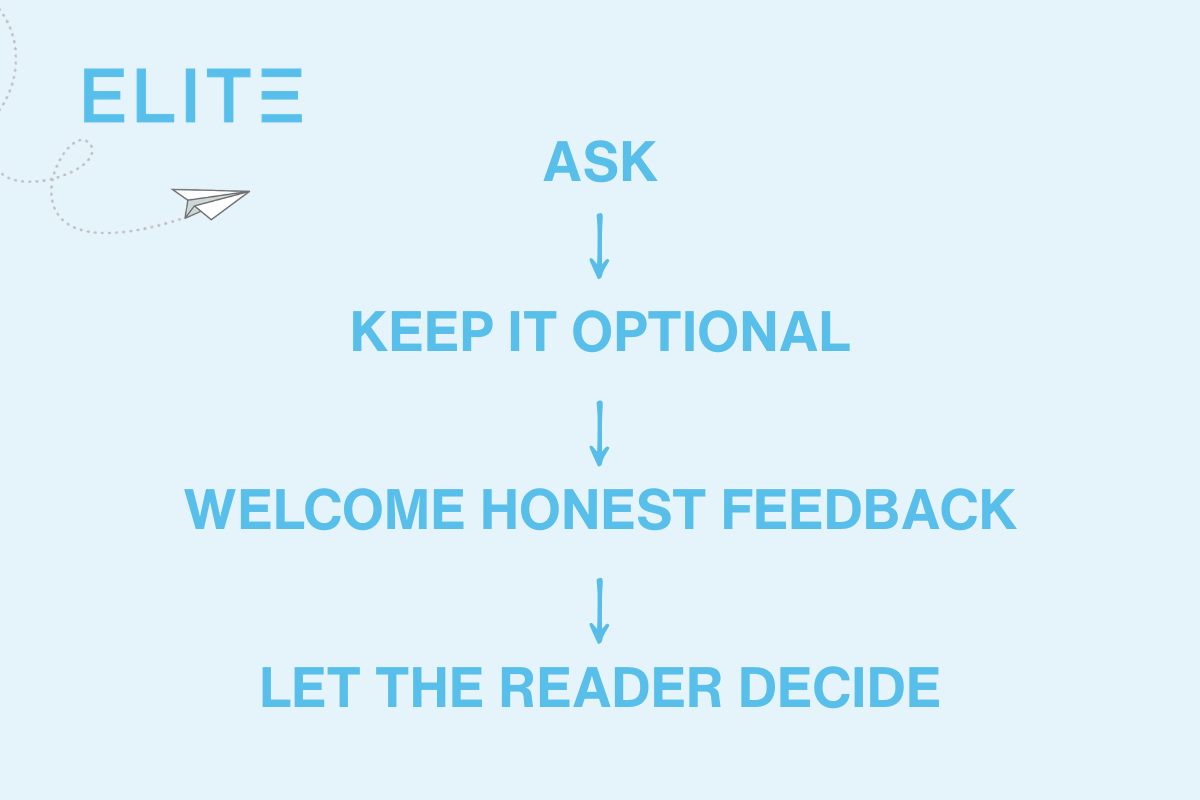
You don’t need a complicated script. A useful Goodreads review request contains four things: context, an optional invitation, permission for honesty, and an easy path to your Goodreads book page.
For example:
“If you’ve finished the book and would like to share your experience, I’d be grateful for an honest review on Goodreads. Whatever your reaction, your perspective can help other readers decide whether the book is right for them.”
That language works because the reader retains every meaningful choice. You aren’t telling them how to rate the book, what to mention, or whether they’re expected to participate.
In your book’s back matter, keep the request short. Thank readers for spending time with the book, invite them to leave an honest review if they’d like, and provide an easy way to find your Goodreads page.
In a post-launch newsletter, the request has more context. You might tell subscribers that reader feedback helps other people understand what kind of experience the book offers, then invite anyone who has finished reading to share an honest review.
On social media, make a general invitation rather than targeting individual Goodreads users. A simple public post gives interested readers a chance to participate without putting anyone on the spot.
Convenience helps. Add a direct link to your book’s Goodreads page when the channel allows it. Just remember that making a review easy to leave shouldn’t make it feel required.
How authors should handle negative Goodreads reviews

A negative Goodreads review can sting, especially after you’ve spent months or years bringing your book into the world. Your best response on Goodreads is usually no response at all.
The Goodreads Author Guidelines specifically tell authors not to engage with people who negatively rate or review their books. Goodreads notes other readers can see those interactions and may perceive an author’s response as hostile, regardless of how carefully it was written. If you believe a review violates the platform’s rules, Goodreads recommends reporting it rather than replying to the reviewer.
That means resisting several understandable impulses. Don’t explain why the reader misunderstood the story. Don’t ask someone to reconsider a two-star rating. Don’t send followers to defend the book. And don’t publicly identify or embarrass someone because you disagree with their opinion.
Reviews belong to the reader’s side of the reading experience. Goodreads describes reviews as individual, subjective opinions, and its guidelines explicitly make room for both positive and negative assessments.
You can still learn from what readers say. If the same thoughtful observation appears across several reviews, you might note it privately and consider whether it offers useful information for your positioning, future writing, or publishing process. One critical review, however, doesn’t require you to defend your book or change direction.
Build a review strategy readers can trust
Ethical review gathering works best as a steady part of your post-launch promotion strategy. Invite readers through channels where they already have a relationship with you, make the request neutral, and accept whatever response follows. Over time, this approach creates something more useful than a collection of praise: It creates independent reader perspectives that help other people judge whether your book fits their interests.
Once reviews arrive, treat their independence with the same care. Preserve a reviewer’s meaning when you quote feedback in your promotion, and choose excerpts that accurately represent what the reader said. If you’d like ideas for putting genuine reader feedback to work, explore how to write and use book reviews across your website, newsletters, social content, and other promotional materials.
You don’t need every reader to love your book, but you do need a review process readers can trust, and you can continue comfortably after launch. Clear boundaries make that process easier because you know what to ask, where to ask, and when to leave the decision entirely with the reader.
Ready to build that foundation? Learn how book reviews for self-published authors support reader trust before you put more attention behind your book promotion.